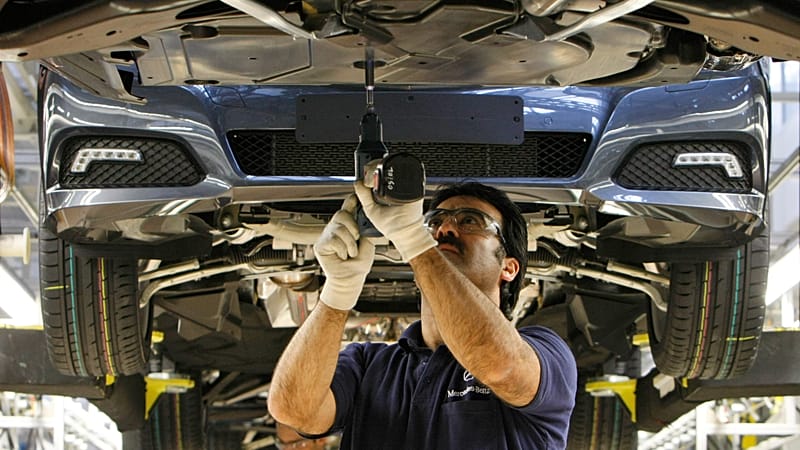
Eurozone manufacturing has moved back into expansion territory for the first time in months, reaching its strongest level since June 2022, according to a closely watched business survey released on Friday.
The flash Eurozone Manufacturing PMI rose to 50.8 points in February from 49.5 in January, a 44-month high, data compiled by S&P Global and Hamburg Commercial Bank showed.
The reading exceeded market expectations and crossed the 50-point threshold that separates contraction from growth.
The broader composite index, which combines manufacturing and services, increased to 51.9 from 51.3, signalling that overall private sector activity in the euro area continues to expand at a moderate pace.
Services activity remained in growth territory at 51.8, though slightly below consensus forecasts.
For much of the past two years, manufacturing has weighed on eurozone growth, reflecting weak global demand, higher energy costs and tighter financial conditions. February’s rebound may mark a shift.
“This could be the turning point for the manufacturing sector as the headline PMI increased to growth territory,” Dr Cyrus de la Rubia, chief economist at Hamburg Commercial Bank, said.
The economist also cautioned that it may be too early to declare a full recovery, but said the underlying fundamentals appear more solid than during previous short-lived upturns.
New orders returned to moderate growth after three months of contraction, suggesting that output could continue to expand in the coming months.
De la Rubia noted that the manufacturing sector now appears to be “on a more stable footing” and could contribute positively to overall growth this year rather than act as a drag.
Related
The improvement was led by Germany, the eurozone’s largest economy and industrial powerhouse.
Germany’s manufacturing PMI rose to 50.7 in February from 49.1, moving back into expansionary territory for the first time in more than three and a half years.
New orders increased robustly, including from abroad, and order backlogs rose for the first time since mid-2022.
“German industry is growing again,” de la Rubia commented, highlighting robust growth in new orders and a modest rise in order backlogs for the first time since mid-2022.
Foreign demand also strengthened after six months of decline.
According to de la Rubia, higher public spending on infrastructure and defence, combined with stronger foreign demand, is helping support the turnaround.
Survey data suggest Germany’s economy may have grown visibly in the first quarter, barring a sharp deterioration in March.
Business expectations for the year ahead have also improved, reinforcing signs that Europe’s largest economy could finally be emerging from its prolonged industrial slump.
France, however, continues to lag behind. The French composite PMI stood at 49.9 in February, just below the expansion threshold, indicating that overall private sector activity is broadly stagnating.
Manufacturing slipped back into contraction after briefly expanding in January, while services output also declined. Demand remains weak, particularly for exports, and hiring activity stagnated.
Jonas Feldhusen, junior economist at Hamburg Commercial Bank, said the French private sector is struggling to gain real momentum.
“The main drag continues to come from the demand side as new orders declined yet again, with the situation looking even worse for export orders,” Feldhusen said.
Although business confidence remains above last year’s average, the lack of sustained growth in new orders points to continued fragility.
The rebound in activity comes alongside renewed price pressures, particularly in manufacturing.
Input costs across the eurozone increased at the fastest pace since December 2022, marking the joint-strongest rise in 34 months. The acceleration was driven largely by manufacturers, while cost inflation in services eased slightly.
Higher energy prices appear to be playing a role. In Germany, crude oil and natural gas prices have risen by roughly 12% to 14% in euro terms since the beginning of January, contributing to stronger increases in purchase prices. Companies were able to pass on some of these higher costs to customers, though the pace of selling price inflation eased marginally at the aggregate level.
In Germany, firms continued to raise charges solidly, while French service providers reduced prices for the first time in three months. Elsewhere in the eurozone, price increases accelerated.
For the European Central Bank, the mixed picture presents a delicate balance. Service price pressures — closely monitored by policymakers — have moderated somewhat, but remain elevated. Meanwhile, manufacturing cost pressures are building again.
With activity expanding and inflation in parts of the economy still firm, the survey suggests the ECB is unlikely to rush into changing its policy stance.
For households and businesses, the key issue is whether the nascent manufacturing recovery can be sustained without reigniting broader inflationary pressures.
February’s figures indicate the eurozone economy is on a more stable footing than in recent months, but the recovery remains uneven and vulnerable to renewed cost shocks.